Houseplants
Terrariums Part 1: Introduction
Part 1 of a 3 part series
A miniature world under glass, terrariums are fascinating and remarkably easy to create and maintain! Over the next 3 posts, I will be discussing everything you need to know about designing, planting, and maintaining terrariums.

I first got into terrariums a few years ago when my colleague James starting collecting glass bell jars and specimen begonias. I must confess his enthusiasm was contagious! I now have two and have given one to my sister. Plants have been grown under glass since Victorian times. In those days they were commonly referred to as Wardian cases, named after Dr. Nathaniel Ward who first introduced society to these mini ecosystems.
It is so easy to grow terrarium plants in enclosed environments, because they need not be constantly watered or groomed. In their native habitat, plants requiring extra humidity were growing on the floor of the rainforest, in tree crevices or on rocks with a thick canopy of growth overhead. The most important things to remember about their care are to keep the containers out of direct sunlight, and to try and keep them on the cool side. Many unsuccessful growers have forgotten that the plants love humidity, but they do not like wet feet.
There are a few things to consider before planting your terrarium:
- Make sure the plants you select are the appropriate scale for the container and the other plants, otherwise it will dominate the design
- Select plants that are completely different from each other in terms of color, leaf shape and growing habit. The key is for each plant to have its own unique personality, instead of them all blending together.
- Don’t be discouraged if a plant doesn’t make it. Terrariums are a learning experience and may take a little time to gauge how much or little water is needed. Proper plant choices will minimize this issue.
Check back in a few days for part 2 of this series: Creating Open Terrariums and more great planting inspiration.
For a quick how-to: Click Here
How to Plant an Orchid
An orchid ready to be pottedOrchid
While light requirements vary depending on the variety, as a general rule most orchids prefer filtered to bright light. For long-term health, orchids do not do well in lowlight environments.
Orchid Pot: Notice the holes for air circulation and drainageOrchid Pot
Orchid roots do not like to be confined. Orchid pots have holes to allow for the best air circulation and drainage for your plants. If you prefer a standard non-perforated pot, make sure the planting medium is extremely loose.
How to Build a Terrarium
You’ll need:
Glass Terrarium ContainerGlass Container
Your terrarium needs to be large enough to contain plants, decorative elements and some “breathing space.” A large jar, fishbowl or shallow glass bowl also work great.
Small Plants: These 1” pots are perfectSmall Plants
Mini plants (as opposed to young plants) will not outgrow the size of the container. Be sure to group together plants that have the same sunlight requirements.
GravelGravel for Drainage
Inadequate water drainage is the biggest problem facing mini gardens and terrariums. A layer of small gravel will allow for your terrarium to drain.
Activated CharcoalCharcoal
A layer of charcoal will filter the water and help prevent fungi from forming in your terrarium. You’ll be glad you added this!
Potting SoilLight Potting Mix
Your soil must maintain the proper balance between water & nutrient retention, and adequate drainage. Mahoney’s Premium Potting Mix is perfect.
Decorative ElementsDecorative Elements
Think of your terrarium as a miniature landscape - use mini decorative figures such as benches, birdhouses, urns, fairies or even mini-houses. Add moss or rocks for a finished look.
How to build your terrarium
- Start off with a bottom layer of gravel,
- Add a ¼ inch layer of gardener’s charcoal.
- Next, add a layer of soil. Arrange your plants and fill the empty spaces around the roots with soil.
- Lastly, you can either do a layer of sphagnum moss or an assortment of other botanicals. I prefer to use lots of different things to add texture, color and visual interest. Some of my many favorites include reindeer moss, lichen, pinecones, pods, river stones and tallow berries. I love talking a stroll through the woods to find some of these mosses, lichen covered branches and interesting stones. A cute little critter nestled in, such as a bird, frog or lizard adds a nice finishing touch. Make sure it is made of resin, stone, or metal so that it doesn’t start rotting or molding over.
If it is necessary to further moisten the container, you may use a turkey baster to add just a bit of water around the edges of the container. After planting, you’ll need to observe the container closely until you can tell if the plant is too wet or too dry. If the sides of the container produce too much condensation, you may wish to blot some of the moisture, although a certain amount of condensation is normal, especially during the warmest and coolest parts of the day. Paper towels are great for this job. If you have over-watered a plant you might even take it out of the container and set it on several paper towels. Terrariums are very forgiving, so don’t be afraid to remove and add plants as you find the perfect balance.
Air Cleaning Houseplants
Airborne toxins such as formaldehyde, TCE and benzene are present in every home and office. That’s because these compounds are found in countless products used everyday: paints, varnishes, plastics, rubber, insulation and particleboard. Even permanent-pressed clothes, grocery bags and facial tissue contribute harmful toxins in the air you breath. Worse yet, symptoms from these toxins include eye, nose and throat irritation, headaches, allergic dermatitis, chronic respiratory diseases and neuropsychological problems. Yikes!
Houseplants fight air pollution by absorbing these harmful contaminants. NASA researchers discovered that certain houseplants can reduce indoor pollutants by 87 percent in 24 hours. So, why not add several plants to your home and office? You’ll love the look and breathe easier, too!
This beatiful plant will grow to be a dramatic feature in any home or office
An easy indoor vine that anyone can grow.
Thrives in lower light – so it’s lovely in dining and living rooms, offices, etc. Purifies the air, too.
A beautiful tree that you can grow in your house.
A houseplant that thrives in either bright or low light!
One of the easiest houseplants to grow - now available in exciting new hybrids.
Looking for a palm that tolerates shade? Stop right here!
Great easy care houseplant for a hanging basket or as a climber!
The perfect match for anyone wanting a houseplant!
A Beginner's Guide to Caring for Houseplants
Good for you! You’ve willing to overcome your fears and adopt a houseplant or two, but first you are wondering how to care for them. Relax. It’s really pretty easy. Plants need light, water and fertilizer to grow and flourish. Different plants have different requirements and some plants are easier than others. If you are a beginner – or if you are really busy and need something low maintenance – start with one of our easy care houseplants. These plants are durable, will handle a range of indoor temperatures in your home and will withstand a bit of watering neglect.
How much light does my new plant need?
This is a key question and one you need to ask BEFORE deciding which houseplant to bring home. Light requirements are divided into 3 groups:
- Full Sun
4 to 6 hours a day direct sun – try a southern exposure. - Medium Light
2 to 3 hours of direct sun, or 6 to 8 hours of bright indirect light, typically eastern or western exposure, or perhaps southern exposure but not placed directly near a window. - Low Light
No direct sunlight, but some indirect light, or even 8 or more hours a day of electric lights (regular incandescent, fluorescent, etc.)
Some plants are more sensitive to light fluctuations than others. For best results pick a houseplant that matches your room’s available light. Look at the plant label to see its group, or just ask us.
How to water your ‘Easy Care’ plants:
After determining the right amount of light, you need to know a little bit about watering. Surprisingly enough, the #1 reason houseplants fail to thrive is OVERWATERING, and that is because many people look at the top surface of the soil to decide when to water. Soil often looks dry on top, even when the plant has plenty of moisture. The real question is how moist the soil is below the surface.
Stick your finger right into the soil to a depth of 2” (about to your second knuckle). Gently pull it out look near the knuckle. You should be able to see if the soil is dry, slightly moist or very wet. Sort of like a human cake tester.
- If the soil is dry at this 2” depth, it is time to water.
- If the soil is slightly moist, wait a day or more.
- If the soil is downright wet at this depth, cut back on how frequently you water.
If possible, water your plants in the morning and use tepid (slightly warm) water.
Water thoroughly and slowly, but stop as soon as water runs through the drainage holes. Make sure that the soil is thoroughly wet when you are finished. If the water runs through the drainage hole too quickly, the pot may be crammed with roots and contain too little soil. In this case it may be time to repot.
Do NOT leave lots of excess water in the saucer – roots can rot if constantly wet. An alternative is to fill your drainage dish with a layer of small pebbles or river rocks. The rocks will keep the bottom of the pot elevated over excess water.
Do I need to fertilize my houseplants?
We regularly feed our houseplants. When you bring it home it is important to continue this care – especially if it is a flowering plant. As a rule of thumb, houseplants should be fed every other week in spring, summer and early fall. As light levels diminish in November, your plant will need less fertilization – once a month or less. Using a complete liquid fertilizer will ensure healthy, thriving plants. Follow package instruction carefully – too much fertilizer can be worse than too little.
Follow these three guidelines and even the most notorious plant killer can enjoy happy healthy plants in many rooms in their home, dorm or office.
Easy Care Houseplants
What to do if you feel you have a “black thumb”
While there’s no such thing as an immortal plant, if you’ve had bad luck before, you’ll be glad to know that Mahoney’s has a number of plants that are easy-care and very forgiving. Look for plants signs that feature our easy care logo. They include tried and true classics, as well as some brand new hybrids. Some of these plants are also proven effective at cleaning the air. Bonus!
Below is a list of plants we call easy care – but first consider these few pretty easy guidelines that will help redeem even the most notorious plant killer.
First, it’s probably not your fault.
No one is born a plant killer. Often the solution is as easy as selecting a plant that likes your environment.
Adjust how much you water.
Watering is a common reason houseplants fail. Oddly enough, too much water is frequently the problem. The wrong pot can also cause even the healthiest plant to expire. Check the care directions, or easier yet, ask us. Often it’s a very simple adjustment.
Don’t take it personally.
Relax. Enjoy your houseplant. See what you can do to keep it happy. But should the need arise bring home a new one. Most plants are not expensive. Many people routinely change their houseplants for the fun of it.
So many beautiful, nearly indestructible varieties to choose from!
Carefree, tough succulent houseplant perfect for beginners!
With almost no care needed, this palm will give you years of happy, healthy, lush tropical indoor greenery.
One of our “Easy Care” houseplants, it’s also one of our most popular dracaenas!
As close to foolproof as a plant can get!
An easy indoor vine that anyone can grow.
Easy to grow, timeless, popular - what more could you ask for?
Thrives in lower light – so it’s lovely in dining and living rooms, offices, etc. Purifies the air, too.
A beautiful, elegant, Victorian palm that tolerates low light and colder temperatures.
A popular plant for offices & homes because of its easy care and wide variety of light tolerance.
A houseplant that thrives in either bright or low light!
One of the easiest houseplants to grow - now available in exciting new hybrids.
Don’t be afraid, this decorator’s favorite is also practically impossible to kill.
5 Winter Tips for Healthy Houseplants
1: Avoid Overwatering
It’s counterintuitive, but overwatering is the most common reason plants fail – particularly in the winter. Overwatering can cause browning of leaves, fungus, gnats, and dropping of leaves. Wait to water your houseplants until they become dry. Test the soil with your finger. When the top inch is dry, then add water.
Nice Idea: Use the same watering vessel each time, so you know to add the same amount whenever you water.
Neat Idea: place a cork pad under your plant’s saucer. This will eliminate water stains on your carpet or hardwood floors.

2: Cleen the Green
Keep your leaves free of dust and grime this will keep your plants healthier – plus they’ll look better. Take a half of a lemon and squeeze it into a quart of water using a soft cloth. Wet it with the lemon mix and wipe gently. Support the foliage using your other hand so you won’t bend or break the leaf. Unless you live in a dust bowl, you’ll probably only have to do this once every six months or so.
3: Feeding
Your houseplants need food during the winter, but less is more. If your directions say 1 tablespoon or 1 scoop we recommend cutting that in half. Feed only once a month until spring. Personally I believe organic fertilizers are better for plants.
Who knew: Using filtered or bottled water will help eliminate dead ends. The minerals in tap water will settle to the ends of the leaves and cause the dead ends.
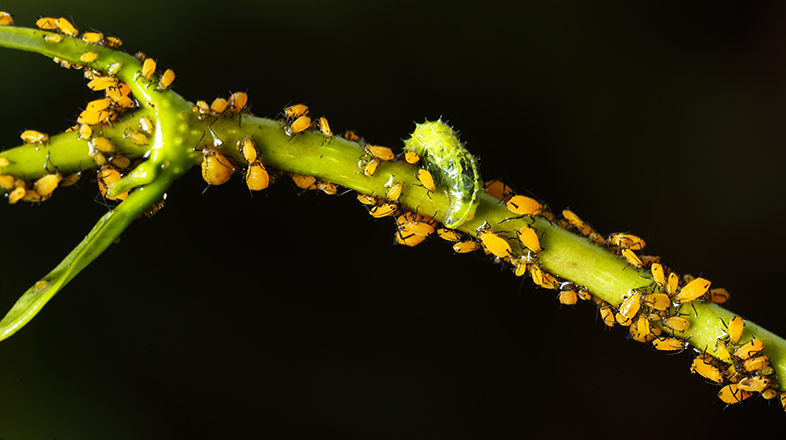
Aphids
Mealy Bug
4: Check for Pests
Keep an eye out for pests. They usually will attack the new growth and also hide on the underside of the leaves and along the stem. They are not harmful to humans and are easily able to control. If you do discover pests grab yourself an organic insect spray. Lay out some plastic under the pot and start spraying at the bottom of the plant.
Spray the foliage on the underside and then on top, working your way up. Your treatments may take several applications 7 - 10 days apart. The sooner you discover those pests, the easier it is to get under control, so check your plants often.
5: Wait to Repot
If you feel your plant needs to be repotted into a bigger container, it’s best to wait to late winter or early spring. Longer daylight hours and warmer temperatures are more conducive to root expansion. Choose a container that is 4 – 6 inches larger than the existing pot. When choosing a pot the saucer is important. You want at least 2” of space between the saucer edge and the bottom of the pot.
Alternative idea: If you cannot find a matching saucer, check out Mahoney’s clear plastic “Super Saucers” – they “disappear” under the pot.
Christmas tree alternatives: Norfolk Island Pine, Cypress, Rosemary
According to my personal survey of friends and relatives, there seems to be a trend among those who celebrate Christmas . That trend is to skip putting up the Christmas tree. I know, hard to believe, but there it is. I have come across three of my friends who just don’t bother. The kids are grown, the grandchildren are not coming, the mess is too much, or the best excuse yet, ‘I am allergic’. In all fairness, the ‘allergic’ person has a fake tree which pops up. A ‘pop up’ Christmas tree!
I am hoping to avoid these excuses as I grow older. I know I am not alone and the child within many of us loves the lights and decorations on a tree, the ritual of picking out the tree, fighting with the spouse over whether it is straight in the stand (this is hard to see when you are holding it inches from your face while he screws it in the stand) and then the magic of sitting in the darkened room with just the tree lights shining. The good news is, most of these friends do have some form of decorated greenery in their homes and there are many choices of potted foliage plants available at the garden centers that require little ritual or drama in order to “make the season bright”.Consider the Norfolk Island pine. This plant, Araucaria heterophylla, hails from the Norfolk Islands in the Pacific Ocean. In its native habitat, it can grow to 150 feet tall. It has a unique outline and symmetrical structure with very evenly spaced, horizontal branches.
It makes a great houseplant long after the holidays and it can be re-commissioned year after year for holiday decorating. A few bows, a strand of lights, and it’s elegantly clad for the festivities. No one could accuse you of skimping on holiday decorating with this plant in seasonal finery. Easy to grow inside, the Norfolk Island pine requires bright indirect light, temperatures above fifty degrees, and even soil moisture. It will thrive while spending the summer outside on the deck in dappled sunlight.
There are several different kinds of mini evergreens available at the garden center and these can also be used for holiday decorating, as houseplants, and then again used in the landscape once spring arrives. The Chamaecyparis lawsoniana ‘Ellwoodii’ is actually a hardy plant in New England and it can grow up to fifteen feet tall. The small potted plant can sit on a hearth or a table and has clean, green foliage in the traditional pyramidal shape. As a houseplant it should be watered when the soil feels dry to the touch and kept in bright light. If you do want to plant it outside wait until the temperatures moderate and gradually acclimate your plant to outside conditions by putting it outside in dappled shade when temperatures are above fifty degrees. Move it over the course of a couple of weeks into sunnier conditions. Full sun and well drained soil will keep this plant in optimal health.
Another evergreen is the x Cupressocyparus leylandii, or golden cypress. This is a lovely golden color. I have kept one over several seasons, training it to a topiary form. It now stands four feet high and has a strand of holiday mini lights adorning it. It always spends the summer outside on the patio in dappled shade and, I confess, the reason it’s a topiary is that I missed several waterings and some of the foliage browned out. No problem. It looks great as a topiary and just requires a few snipets now and then to keep it neat.The plant of remembrance, rosemary, Rosmarinus officinalis, is a deliciously fragrant kitchen herb and its name is derived from the Latin words ‘ros’ (dew) and ‘marinus’ (of the sea). Dew of the sea is quite a visual term and while it does grow near the sea in its native Mediterranean habitat, it can be grown quite well in any heated home. It’s available as a tree-shaped topiary during the holiday season and would be a welcomed gift or festive houseplant.
A rosemary plant can live for many years if you keep just a few tips in mind. Rosemary hates both wet feet and dried-out soil. Watering should be done when the soil feels dry to the touch. You will get a feel for the moisture level if you lift the pot and make a note of its weight. Check the weight by lifting the pot right after you water it and then again every few days as it dries out. If you pay attention to the weight of the pot you will acquire a gardening skill employed by many seasoned gardeners. The pot will be light when dry. The keys to its long life as an indoor plant are full sun, adequate air circulation in the form of a fan, if necessary, and cool temperatures I’ve killed my share of rosemary plants. Don’t worry about it. Just enjoy its presence for a short while as you do other seasonal plants. Growing rosemary is a bit of an acquired skill but it’s well worth having a plant or two on hand for fragrance, color, and culinary purposes.
One last plant that I found at the garden center for holiday sale is the olive tree, Olea europaea. The olive has an ancient history and has been cited in the literature of Homer and the Bible. It was an olive branch that a dove brought to Noah on his ark to signify that the floods were over. Olive oil was used in the ancient Olympic games for the Olympic flame. A symbol of peace, fertility, wisdom, and purity, the olive tree is attractive, with silvery gray foliage. It is native to the Mediterranean region and is easy to care for as a houseplant. It requires bright light and watering when dry. Not as finicky as a rosemary plant, the olive tree is well grown in a six-inch clay pot and could be just the gift for that member of the family who ranted at the Thanksgiving table. Offering an olive branch as a sign of peaceful intentions was penned by Virgil in his great work, the Aeneid, written in 29-19 BC. It could be just the plant needed to remind you of peace during the busy holiday.
The top five 'other' flowering plants for the holidays - Cyclamen, Gloxinia, Amaryllis, Paperwhites and....Hydrangea?
Believe it or not, some people just don’t like poinsettias. Certainly not the majority of people, but if you are one of them, don’t despair. There are several seasonal flowering plants which will give you months of satisfaction as flowering houseplants. What hostess would not be thrilled with a ‘green’ gift that’s just a bit different from the six poinsettias she/he already has lining the banquet table?
First in the line up is the cyclamen. Now there are hardy cyclamen that bloom outside in the garden, but the more common version is the florist’s cyclamen, (Cyclamen persicum). This plant grows from a tuber and is native to the Mediterranean region of the world. In its natural habitat, it blooms in the cooler, damper weather of fall, winter, and/or spring and it goes through a dormant cycle during the dry months of summer. This will give you a key to how best to care for a cyclamen. They prefer temperatures between 55F-65F, bright light and good air circulation, and they can be watered from the bottom. If you do water from the top, water at the sides of the container since the tuber should be kept dry. Your cyclamen will last several months. When picking a cyclamen plant, pick one with just a few flowers open and lots of buds.
Gloxinia (Sinningia speciosa) is a member of the Gesneriaceae family, which is the same family as African violets and the cape primrose. As such, it also prefers warm indoor temperatures and bright indirect light. It differs from its family members in that it grows from a tuber, and tubers generally have a dormant stage. Gloxinias are native to Brazil and come in a wide variety of flower colors. They are rich and velvety in both leaf and flowers. Lush is the word that comes to mind and we all need a bit of lushness in our lives.
Amaryllis are well known to gardeners and non-gardeners alike. They have huge, very satisfying flowers and are available in an array of colors. Amaryllis kits are readily available at this time of year and they’re a great project for both adults and kids. The amaryllis is actually in the genus Hippeastrum, and it originates in tropical and sub-tropical areas of the Americas. Pot them up, water them and watch them grow. Amaryllis bulbs can be kept from year to year. Once the flower has bloomed, cut off the stalk and let the foliage develop. Put it outside during the summer months and fertilize every two weeks. Bring it back in the house before frost and wait for the flower stalk to emerge.
Paperwhites, narcissus species, are as easy to grow as amaryllis. This tender bulb is best planted in a group either in soil or in marble or glass chips. Planting them in a straight-sided clear vase will keep them tidy but they can always be prettily tied with raffia and stakes to keep them upright. When planted in clear marbles where the roots are visible, there is the added dimension of watching those silky thread-like roots infiltrate the marbles. Keep a ruler handy and let the kids chart the growth each day. Their fragrance is heady and pleasant to some, though not to all. Cooler room temperatures keep the plants a bit shorter and bright light also helps.
Yes, there is a hydrangea available for Christmas sale and it is a beauty. Shooting Star Hydrangea is actually a Hydrangea macrophylla ‘Hanabi’, which is a tender hydrangea, hardy in warmer zones than ours. It has both fertile and infertile flowers and is a member of the lacecap variety of hydrangeas. The white, star-shaped infertile flowers shoot off from the main cluster of small blue fertile flowers. It is lovely to behold and easy to grow. Water when dry to the touch and keep this plant in bright light and moderate room temperatures.
One last suggestion for the person in your life who has a black thumb. Try a tillandsia. As much art as greenery, tillandsias - air plants - require only infrequent misting to maintain their health. There are tiny tillandsias and larger varieties, but these little mini-greenhouse ornaments available at the garden center make a perfect conversation piece in your home or as a gift to that person who can kill a silk plant. It is all about choices and there are enough to please everyone.
Bringing the Garden Indoors for the Winter
One characteristic of many avid gardeners is their inability to let go of any plant. It’s difficult to divide and throw out extra plants and it’s just as difficult to leave the tender perennials and annuals outside to succumb to nature’s inevitable advance of cool temperatures. I did heed the advice of Peter Vera in his blog entry (here) written in September and brought the houseplants back inside, but the tender perennials and choice annuals that were in outdoor containers had to wait until time allowed for them to be dug, cleaned, and re-potted for the indoor garden. A frost is past due so I’ve tempted fate for too long, so this past weekend was the time to choose which plants to overwinter and which to leave to their demise.
The bird’s nest fern, Asplenium nidus, has gotten huge and it’s a luscious green. This plant should be easy to overwinter in bright, indirect light and the warm temperatures of the house. It does require a bit more humidity than is usual indoors in the winter, so I will plan on putting it on a humidity tray when the heat goes on this fall.Another container plant that’s just too interesting to leave out in the cold is the Cordyline ‘Mocha Latte” with its great tricolor leaves. Cream, green and brown markings are a unique combination and one that works well with many other colors in a container planting. This cordyline is different from many of the others available in that it has wide leaves. It’ll overwinter in cool, bright light.
Succulents also lend themselves well to the indoor garden. They are very low-maintenance and require infrequent watering, bright light and warm temperatures. This one, Cryptanthus ‘Black Mystic,’ has interesting horizontal variegation and it currently has a small, white, star shaped flower in its center. I did bring in many other plants, including ivy, coleus, phormium and begonias, including this one with dark foliage.
The indoor garden will provide sustenance through the winter months. I know that some plants will thrive and some will just survive until light levels increase and they can once again spend the warm weather and sunny months outside.
Did you bring any of your tender perennials in for the winter? Which ones?